
News
5 Signs Your Marketing Data is Trapped in Silos (And How to Set It Free)
Posted 15th January 2026
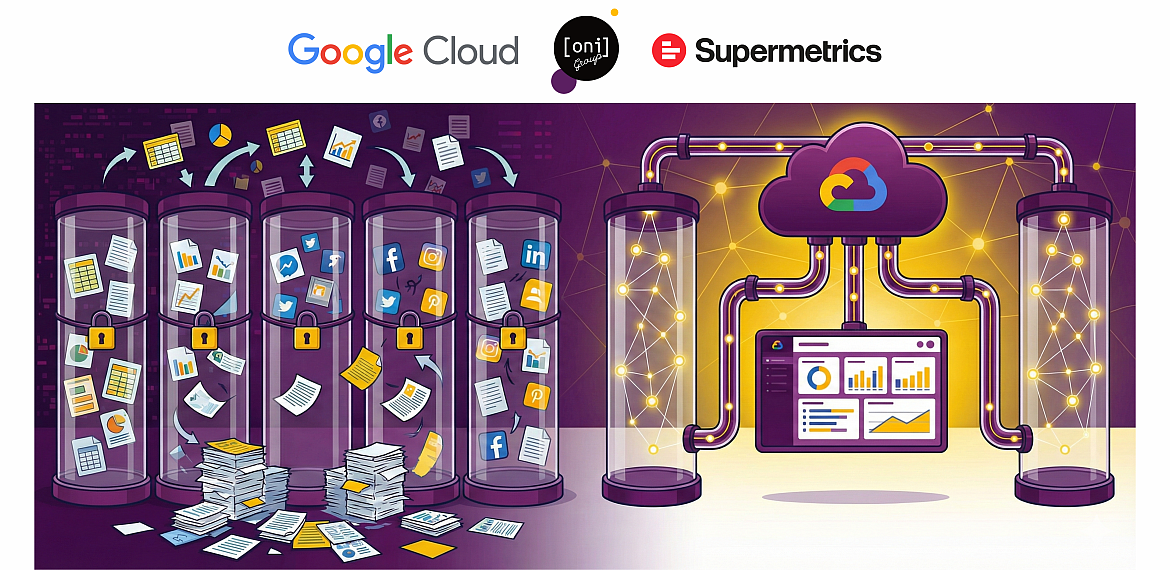
Marketing teams are using 230% more data than they did in 2020, yet insights remain harder to access than ever.
The 2025 Marketing Data Transparency Report by Supermetrics reveals that 38% of marketers struggle most with fragmented data and reporting. The issue isn’t more data, it’s disconnected data.
At OniGroup, we help organisations unify marketing data into a single source of truth. Below are five signs your data is trapped in silos and how to break them down.
Sign #1: You Lack a Single, Transparent Source of Truth
Marketing teams often track every click, scroll, and impression, yet 26% of marketers report that finding relevant insights remains their primary challenge.
The issue is rarely a lack of volume; it is a lack of connection. When metrics are scattered across isolated platforms, they become noise rather than signal.
The Solution: Marketing Data Warehouse
True transparency is achieved by consolidating data into a single location. The standard for solving this is a centralised Marketing Data Warehouse. By automating connections between scattered marketing channels (using tools like Supermetrics) and warehousing that data in a cloud environment (like Google BigQuery), organisations can break down the walls between platforms. This establishes a single, transparent source of truth, enabling a full picture of performance without the need to toggle between dozens of tabs and spreadsheets.
Sign #2: You Cannot Prove ROI
If you cannot draw a straight line between your Google Ad spend and a closed deal in your CRM, your data is siloed. 41% of marketers find it difficult to measure ROI. This is often because they are optimising for online clicks (which live in the ad platform) rather than offline revenue (which lives in the CRM).
The Solution: Closing the Loop with Offline Conversions
By implementing Offline Conversions using tools like Google Analytics, Tag Manager, and your CRM, unique identifiers (such as the GCLID) can be captured at the enquiry stage and fed back into the ads platform. This allows bidding strategies to be based on actual revenue outcomes rather than just lead volume.
- Real-World Impact: In one documented case, a leading property client gained 100% visibility into their customer journey. By feeding offline sales data back into Google Ads, they achieved a 35% decrease in Cost Per Acquisition.
Sign #3: Manual Reporting is Your Part-Time Job
How many hours a week are spent copy-pasting numbers from various ad managers into a spreadsheet? 56% of marketers say they simply do not have time to analyse their data thoroughly because they are too busy compiling it.
The Solution: Automated Pipelines & Visualisation
Marketing teams can reclaim time for strategy by shifting from manual entry to Automated Pipelines. The modern standard involves automating the extraction of data from siloed sources (like Meta, LinkedIn, or TikTok) and normalising it within a data warehouse.
This infrastructure establishes a single source of truth where data is cleaned and aggregated automatically. Once in place, visualisation tools like Looker Studio can be layered on top to generate automated reports and dashboards, ensuring stakeholders see live performance data without manual intervention.
Sign #4: You Have Trust Issues with Your Dashboard
Do reports ever trigger the feeling that the numbers "just don't look right"? Inconsistent naming conventions and duplicate entries create a "garbage in, garbage out" cycle. With 38% of marketers struggling with a lack of data integration, messy data is a common reason for eroded trust. If stakeholders cannot trust the input, they will not use the output.
The Solution: Data Governance Standards
Trust is built on consistency. High-functioning data stacks rely on strict Data Governance protocols to ensure that data is standardised before it ever hits a dashboard.
This involves implementing validation rules at the source. For example, ensuring 100% of enquiry forms capture necessary tracking IDs (like the Google Click ID). By standardising how data is collected and named at the ingestion point, the final reporting output becomes valid, complete, and audit-proof.
Sign #5: You Are Unprepared for the Cookie-Less Future
The industry is shifting. 57% of marketers predict difficulty in attribution and measuring marketing as third-party cookies decline. If a current measurement strategy relies heavily on third-party data pixels, that silo is at risk of collapse.
The Solution: First-Party Data Foundations
The most secure investment for the future is in owned data. 87% of marketers are now prioritising a First-Party Data strategy to future-proof their measurement.
Organisations are pivoting away from "rented" audiences by using Customer Data Platforms (CDPs) natively on cloud infrastructure like Google Cloud or Supermetrics Data Platform. This ensures ownership of audience data in a secure environment, allowing for activation, targeting, and personalisation regardless of future browser changes.
Is Your Data Disconnected?
If you feel like you are drowning in spreadsheets, you are not alone. The problem is not a lack of data. The problem is that the data is not standardised and it certainly is not connected. When Ads data lives in one room and CRM data lives in another, they are trapped in data silos.
We are offering a complimentary, no-obligation workshop to help identify the disconnects in your current set-up and strategise the best way to bridge the gap between marketing data sources.
If you want to read more from the Supermetrics report you can download a free copy here: https://discover.supermetrics.com/marketing-data-report-2025/